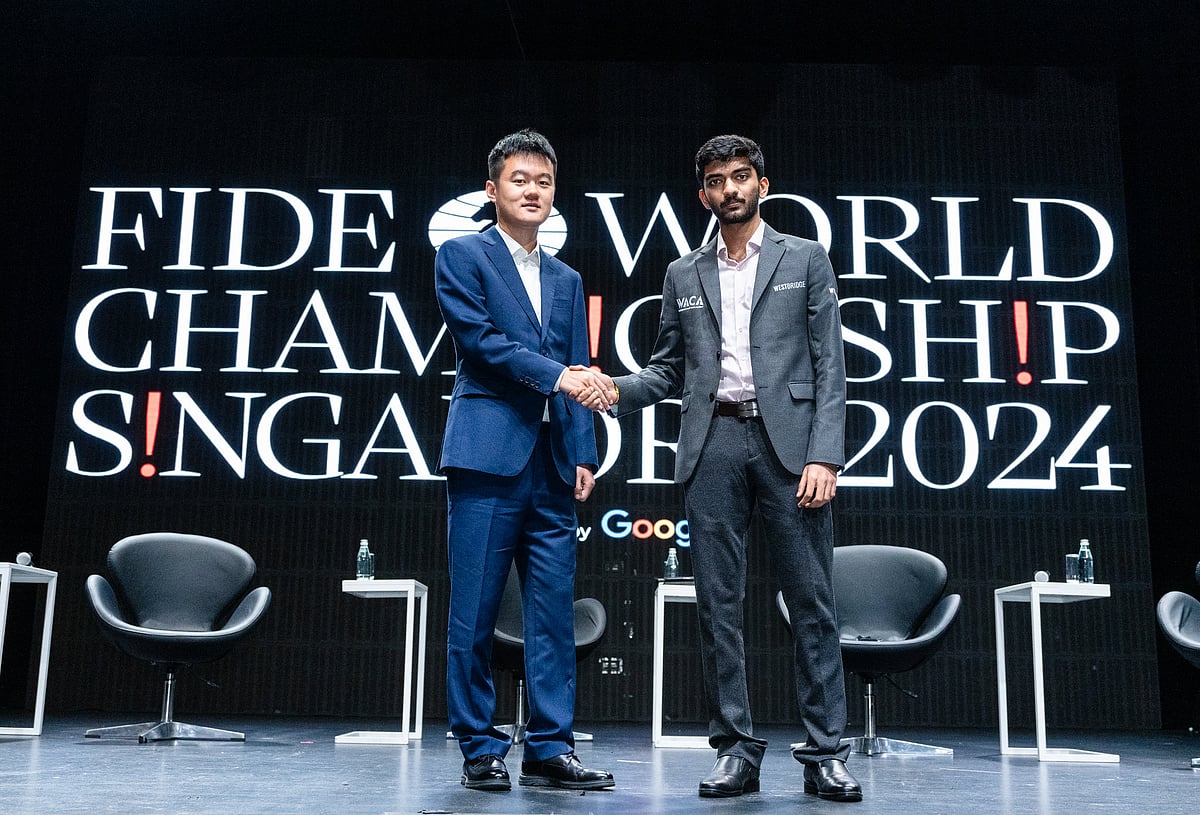

SINGAPORE: Starting Monday, young GM has the chance to make history and take Indian chess to new heights when he begins his quest for the world title against Ding Liren.
On November 23, 2014, Viswanathan Anand, the owner of five world titles, tried for one final time. But the young world champion, Magnus Carlsen, kept the door shut. In the Russian resort town of Sochi, the Norwegian, playing with white, took an unassailable lead to signal the end of Anand’s challenge.
As Anand watched on, Carlsen celebrated. 6.5-4.5.
Since then, Carlsen and others have battled to be in the winner’s circle, to win chess’s ultimate honor the World Championship.
Ten years and a few days later, an Indian will again have the chance to script history when the latest edition of the World Championship commences in Singapore on Monday.
For somebody who has already rewritten some records, D. Gukesh, still only 18, has the opportunity to walk on water and reach a place where no other chess player in history has ventured: to become the youngest world champion. Can the youngest Candidate in history do it?
If Anand’s first world title in 2000 was India’s own moon landing event, then as long as Gukesh can emulate ‘my inspiration,’ it will be India formally opening a colony of its own a modern chess superpower rubber-stamping its dominance across 64 squares.
How did a country, recognized as the founding father of one of the first versions of chess, get here? The short answer? A perfect storm meant the road to Monday had been in the making for at least the last decade. The long answer? Here’s Srinath Narayanan’s take, the player-turned-coach who recently played a big role in the Open team winning gold at the Olympiad in Hungary. “It has been building up for a very long time,” he tells this daily. “What has happened in the last 24 months started 10-12 years ago when all these kids were growing up. A generation of talented prodigies growing up and getting good guidance along the way. I think a number of things came together. Now, we are here.”
It all began when Anand won his first title in 2000. Young parents suddenly saw chess as a viable career option. If nothing else, they saw the game as a ‘very intellectual one’ and ‘very safe to play.’ So, they encouraged their kids to play the game, at least at the recreational level. That sentiment has been more prevalent in South India.