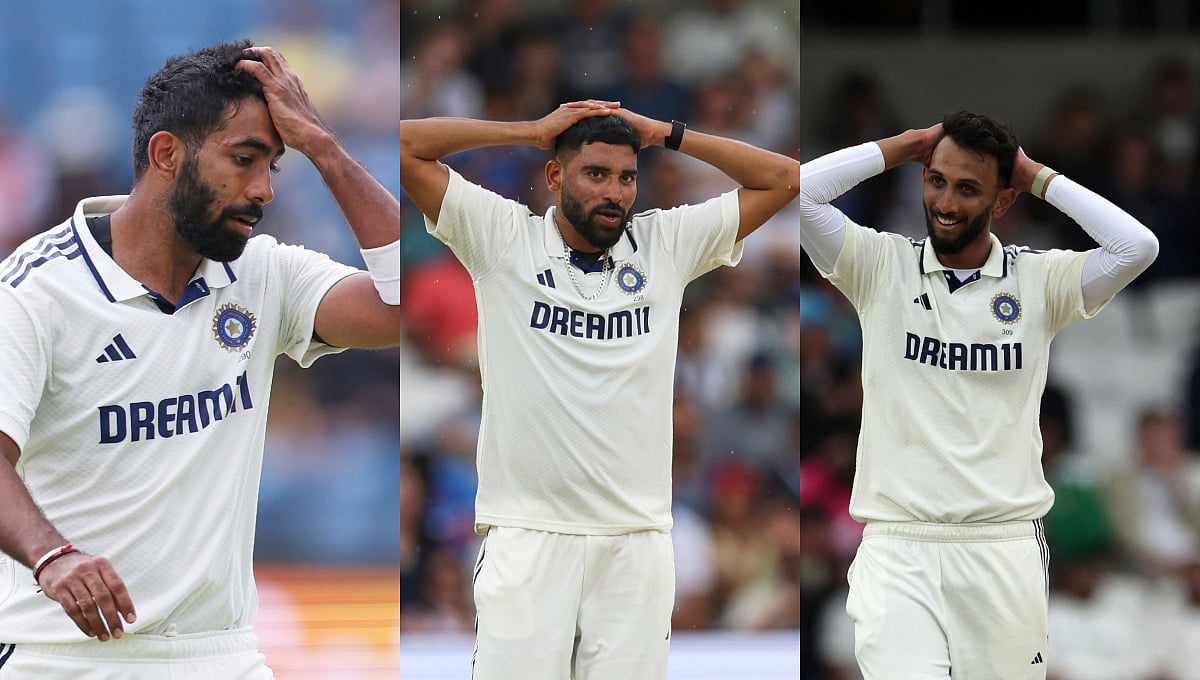
CHENNAI: For a moment, it didn’t feel like New York. It was more like time had gone back to January of this year in Cape Town. India and South Africa played the shortest Test — in terms of number of deliveries — ever in the history of the sport.
During the two-day affair at Newlands, the ball was swinging and bouncing unpredictably as batters fell like a deck of cards. 33 wickets fell in just 642 deliveries. Such was the nature of the conditions that the International Cricket Council rated the Cape Town pitch “unsatisfactory”.
Cut to Wednesday, India were once again in the middle. This time, not in a Test match, but a T20 World Cup game against Ireland. Their first of the tournament in another new land for the sport – the United States. And yet, it all felt the same.
Arshdeep Singh, sharing the new ball with Mohammed Siraj, was making the ball swing both ways from the very first over at the Nassau County Cricket Stadium – a modular venue that was built for the tournament. Granted it was an early morning start in the US, catering to the sub-continental television audience, and there was moisture in the air. But there was more.
In the next over, Siraj did one better. Or rather he didn’t have to. The pitch did. On the fourth delivery, Siraj pitched one on the goodish length and the ball leapt over Andy Balbirne, leaving Rishabh Pant to do a goalie and grab it with one hand. Testing the batter apart, it also left a seed of doubt on every batter who walked in. They were not going to get on the front foot unless it was overpitched.
The result? Paul Stirling, caught in the crease, tried to heave Arshdeep only to find the leading edge and was caught. Four balls later, Balbirne was stuck trying to guide an outswinger only to lose his off-stump to the left-arm seamer. It seemed more like an overcast day one of a Test match.
Over the next few overs, Lorcan Tucker and Harry Tector tried to read the bounce and movement of the pitch, leaving them prone to all kinds of trouble. That the deliveries pitched on the same length were bouncing over head and keeping at knee-length did not help the cause either. Jasprit Bumrah would come in, even bowl some wobble seam, and deliver a maiden. Then Hardik Pandya, who often bowls back of length, tried to attack the stumps and reaped the rewards. A sharp inward movement between the bat and pad of Tucker to clean him up.
With Bumrah’s back of length delivery lifting and hitting Tector in the helmet after taking an edge, Ireland lost the core of the batting unit, stuttering at 36/4. From thereon, it was only a freefall of wickets as Ireland were all out for 96 in 16 overs. The trend continued during India’s batting as well with Rohit Sharma getting hit on his right arm off a delivery that rose sharply of good length. The skipper, meanwhile, held his own. He hit a fifty to take India closer to the target before walking off the field retired hurt. Even Pant too get hit a few times before India eventually got home.
In the lead up to the global event, all the talk had been about the lack of buzz and uncertainty about the conditions. The drop-in pitches for the US venues had been prepared in Adelaide before being grown in Florida and installed at the venues. No one knew what to expect from these pitches. However, when South Africa and Sri Lanka played out a low-scoring affair in New York’s first World Cup match, it threw light on the lack of preparation of not just the surface, but also the outfield to an extent. The surface was fast and uneven while the outfield was remarkably slow.
While there were no answers to the questions about the surface, India-Ireland was played on a different one – the same as the warm-up match Rohit Sharma & Co. played against Bangladesh. India scored 180 runs on the surface and was hoping that the game against Ireland would be similar. But that wasn’t the case. That Rohit, who said India will need four spinners, went into the match with four seamers and two finger spinners summed up the nature of the surface. Which begs the question whether the ICC should have scheduled more matches on these pitches before the global event to ensure that the pitches are tried and tested.
It is only the eighth match of the T20 World Cup, second in New York, and one will have to wait and see how the remaining matches play out. However, early signs indicate that the global body might just have botched an excellent opportunity to introduce the sport to a new audience.